

Tips & Tricks
Different manufacturers may have different guidelines. Always follow your specific manufacturer’s recommendations.
Glass
- Use a mild glass cleaner, mild white vinegar and water solution, or mild soap and water along with a soft clean microfibre cloth to wash the window.
- To minimize streaks:
– use a soft, lint-free cloth to dry
– clean your windows on a cool, cloudy day to avoid window cleaners drying onto the glass - Never use anything sharp or abrasive (razor blades, plastic blades, scrubbing pads) to clean the glass, as this can cause permanent scratches
- Do not use a pressure washer or high PSI device to wash your windows
- If your windows are quite dirty, they may require multiple rounds of washing and drying
Frames
- Vacuum dirt and dust from the windowsill and track. Mold will not form on vinyl itself, but it will form on organic matter (dirt, dust, etc.).
- Never use any chemicals or sharp/abrasive tools as this can damage your frames. For stuck-on spots, use a mild soap and water with a soft cloth.
Screens
- Vacuum with a handheld brush attachment, or alternatively remove and rinse them with mild soap and water and let air dry thoroughly before reinstalling.
Windows and Water
UNDERSTANDING CONDENSATION
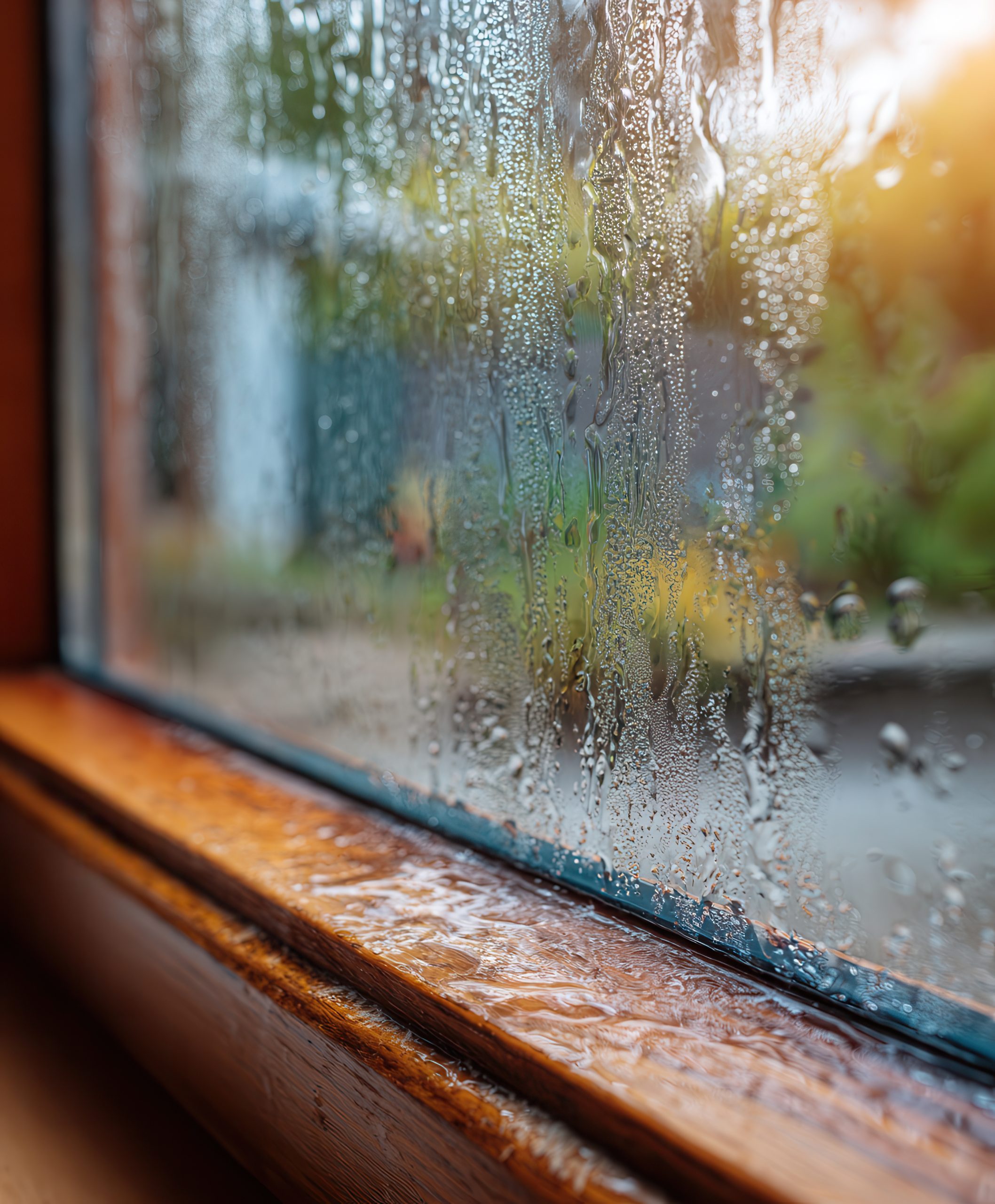
Condensation typically occurs when the warm moist air from inside your home meets the cold surface of the glass. Interior condensation can be a sign of excessive humidity, poor ventilation or low-quality windows – depending on the outside temperatures when this occurs. Higher quality windows will have better insulating factors, and as such, generally will take colder temperatures before condensation occurs.
Signs of condensation
- Water accumulation on the inside window pane, normally more towards the bottom
- Small accumulations of water at the bottom of the window or in the track or frame
Under no circumstances should there be moisture build up between the panes of glass. If this is occurring, it is likely caused by an internal seal failure.
Tips to manage and prevent condensation
- Reduce indoor humidity by using dehumidifiers, exhaust fans and ensuring proper ventilation throughout your home, especially during activities that generate moisture such as cooking, dishwashing, bathing and laundry.
- Increase air circulation by allowing air to flow freely around your windows. By keeping your blinds or curtains closed, moisture can become trapped causing condensation to build quicker. Leaving your curtains open, even by a small amount at the bottom, can help mitigate this.
- Improve the insulating qualities of your windows by minimizing temperature differences between the interior glass pane and the exterior conditions. Old and/or low-quality windows have fewer insulating qualities, i.e. lower qualities of vinyl or glass. Higher quality windows will have higher efficiency, i.e. there will be more insulating factors. In general, when the interior pane of glass is more protected from the exterior temperature differences, it will take much colder conditions before condensation and ice buildup become an issue.
All About Energy Efficiency
WHAT IS NAFS?
North American Fenestration Standard (NAFS) is the performance and quality requirements for windows, doors and skylights in Canada. NAFS provides guidelines and criteria for the design, manufacturing, testing, rating and labelling for fenestrations in residential and commercial buildings. Any product that has not been tested or certified does not comply with National or Provincial Building Code specifications.
NAFS Certified products undergo strict testing to represent the performance traits from multiple tests such as design pressure, resistance to both water penetration and air leakage, operating force, durability and longevity.
Argon
Argon gas can be used in the manufacturing of double, triple or quad pane windows to increase energy efficiency. Argon is an odourless and colourless gas that, when placed between the panes of glass, performs as a thermal insulator and reduces heat transfer.
Low-E
Low-E is an abbreviation for low emissivity and refers to a coating that is placed on window glass to reduce the passage of certain wavelengths of solar radiation. This layer is virtually invisible, transparent and only slightly tinted to facilitate the transfer of natural light. These coatings can have a significant impact on energy efficiency. There are different types and formulations of Low-E coatings – each able to be used in different ways for optimal control and performance. Thus, it is critical to choose products manufactured for your specific climate and region.
U-Value
U-value, also known as a U-factor, is the insulating performance of glass, specifically the amount of heat transfer that occurs. A lower U-value indicates lower levels of heat transfer and thus better insulating properties.
R-Value
R-value measures the performance of other materials compromising the building envelope. Opposite of the U-value, R-value measures the thermal resistance. Thus, a higher R-value indicates better performance.
SHGC
Solar Heat Gain Coefficient (SHGC) is a measure of how efficiently a window or other fenestration blocks solar heat. SHGC is expressed as a ratio, where 1 equals the maximum level of solar heat transfer allowed through a window, and 0 equals the minimum amount possible. A rating of 0.45 indicates that 45% of the available solar heat can pass through the window. This rating generally includes the entire window assembly, frame and all. For this rating, application context is important. A lower SHGC indicates a higher efficiency of blocking solar heat and is ideal for hot climates with lots of sunlight; while a higher SHGC is beneficial for northern climates wanting to take advantage of radiant heat from the sun in the colder months.
ER - Energy Rating / ENERGY STAR® Certified
Energy Rating (ER) can be one tool that can help consumers compare the efficiency of vertically installed fenestration – i.e. windows and/or doors. Three metrics are used to calculate ER: U-factor, Solar Heat Gain Coefficient (SHGC) and air leakage. In short, the higher the number, the more efficient the product.
There is, however, some debate in the industry about whether using the ER alone is sufficient for assessing your new windows in Canada & Northern Climates. As the SHGC is one value that is considered when calculating the Energy Rating, it’s important to remember that a “good” or “bad” rating varies, and depends on the climate where you are located. For example, a higher SHGC is beneficial for northern climates wanting to take advantage of radiant heat from the sun in colder months, while a lower SHGC would benefit southern climates. Lower SHGC values can reduce cooling costs, while higher SHGC values can reduce heating costs. With the Okanagan’s hot summers, and cold(ish) winters, ER can be a helpful tool, however it may be worthwhile to consider all the metrics used for your specific application.
ENERGY STAR® certified windows, doors and skylights have been tested against current standards by an accredited laboratory. Those test results have been verified by an independent third party.
For more information on energy and performance measurements, please visit:
Energy Star Canada – Technical Specifications : Windows, Doors & Skylights